

Providing a dog with the best nutrition is very important throughout its life, especially when it’s a puppy. The first few months of life are the most critical. Energy supply It needs to, because that’s when it grows fastest and its body is forming bones, muscles and nervous systemTherefore, if we choose to feed them kibble, we need to know when to change food from puppy to adultbecause doing it too early or too late could lead to problems nutritional deficits or overnutrition.
In addition to age, it is essential to take into account the dog size, its expected adult weight, its level of physical activity and whether it is or not sterilizedAll these factors influence both the ideal timing of the change and the type of adult feed that suits him best.
When should you switch your puppy’s food from puppy to adult food?

Puppy food has much more protein y fat than those for adult dogs, in addition to a higher concentration of Vitamins y minerals such as calcium and phosphorus. They are designed to cover some very high energy needs and to promote proper growth. For this reason, we shouldn’t continue giving them the same food indefinitely, as it could fatten or receive an excess of nutrients that your body no longer needs.
Dog food bags often indicate that, once a dog reaches a certain approximate age, it should start eating adult food, but the truth is that not all dogs reach that age. physiological adulthood at the same time. The change should be made when the dog its growth has endednot only when he/she reaches a certain age.
As a practical rule that frequently appears on packaging and in basic advice: small dogs (up to 10 kg) They usually change about the 10 months, medium (10–20 kg) around the year and we will announce, and large (>20 kg) towards the year and a halfHowever, more precise values differentiated by size would be as follows:
- Small dogs (up to about 10 kg adult weight)They usually finish developing around the 9-10 monthsIn many cases, from that age onwards, the change to adult feed can be considered.
- Medium-sized dogs (approx. 11-25 kg adult weight): its development is usually completed between 12 and 14 monthsTherefore, the change in feed falls approximately within that range.
- Large dogs (approx. 26-44 kg adult weight)They require a longer and more controlled growth period; in general, they reach adulthood between the ages of 15 and 18 months.
- Giant dogs (over 45 kg adult weight)These are the ones that take the longest to finish growing, potentially needing between 18 and 24 months to complete their bone and muscle development.
Once it finishes growing, then we can give it a Food for adult dogsIt should be kept in mind that these ranges are guidelines: the musculature of the race, the sex, the state of sterilization, possible joint pathologies and the lifestyle (More or less exercise) can slightly advance or delay the ideal time for change. Therefore, it is always advisable consult the vet to confirm that the puppy has completed its growth curve.
Differences between puppy food and adult dog food

Puppy food and adult dog food don’t just differ in kibble size. They are formulated for different life stages, with very different nutritional and energy needs.
Puppy food stands out for its greater energy densityThey need more calories per kilogram of weight than an adult. In fact, between 6 and 8 weeks of age they may require almost three times the calories than an adult dog, and this need decreases as they grow. The proportion of good quality proteins, healthy fats and minerals such as calcium and phosphorus for proper bone formation.
Adult food, on the other hand, is tailored to maintain ideal weight and to cover maintenance requirements, not growth. Therefore, it usually contains a lower caloric concentration and balanced levels of nutrients that help prevent obesity and associated problems such as joint or metabolic disorders.
Another key difference is the croquette sizePuppies’ teeth are smaller and easier to chew, adapted to their size. jaw and their still limited bite strength. In adults, kibble is usually larger to promote good chewing. chewing and help the dental care.
What happens if you use an inappropriate feed for the stage of development?
If the timing of the change is not calculated correctly or the dog is given food that does not correspond to its stage, various problems can arise:
When it is offered regularly puppy food for an adult dogthe animal receives an amount of nutrients and energy higher than needed. This can lead to a condition of overnutrition and greatly increase the risk of obesityas well as disorders in organs and joints due to excess weight.
If the opposite occurs, that is, if it happens adult food for a puppy consistently, it’s easy to not get the specific nutrients for growth It requires in its first months: proteins, minerals, and vitamins in the right proportions. In this case, the puppy can develop nutritional deficitsgrow inadequately and present, in the medium and long term, bone and joint problems or a weaker immune system.
In large and giant breeds, excessively rapid growth due to supercharging or an unbalanced diet can contribute to joint diseases such as hip dysplasia and hypertrophic osteodystrophyThat’s why it’s so important to respect the growth curves specific to each size of dog and use the correct food at each stage.
Tips for switching from puppy to adult food
The digestive system of dogs, especially in the puppy and young dog stage, is quite sensitiveA sudden change in diet can cause diarrhea, vomiting, gases or episodes of constipationFor this reason, the change of feed should always be done in a progressive and slow.
A practical way to do this is to gradually mix the new adult food with the old puppy food:
- Day 1 and 2: about 25% new feed and 75% of the old feed.
- Day 3 and 450% new food and 50% of the old food.
- Day 5 and 675% new feed and 25% of the old feed.
- Day 7: You can now offer 100% of the new adult feed.
If the dog has history of digestive problems, such as childhood parvovirus, frequent gastritis, or food allergies, it is best extend the transition period up to 10-14 days and always do so under the supervision of the veterinarianDuring these days it is important to observe if signs such as the following appear: vomiting, persistent diarrhea, apathy or itchy skin, which could indicate that the new food does not agree with him/her.
It is also normal for the dog to show some resistance to taste changeIn these cases it is advisable to have patienceDon’t offer too many alternative treats and maintain regular feeding times so that he gets used to the new food.
How to choose a food for adult dogs?
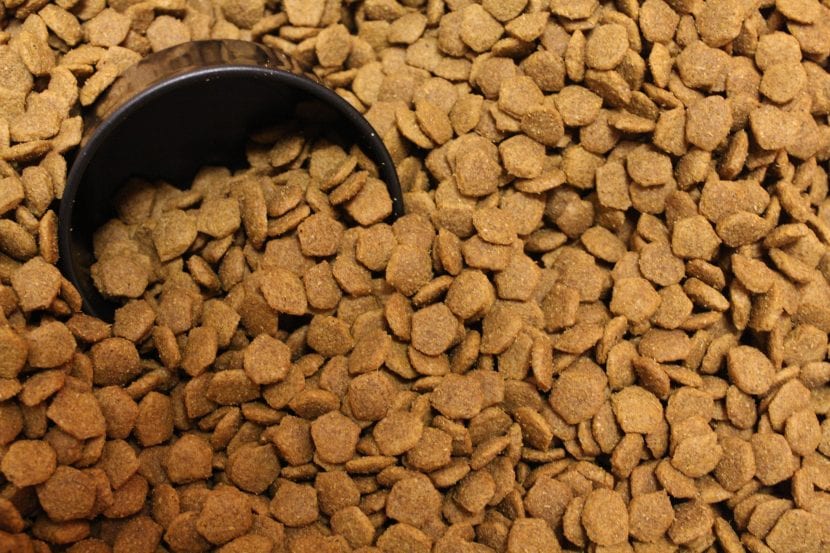
In pet stores and supermarkets, we’ll find a wide variety of dog food brands. But how do we choose the right one for our dog? It’s essential to look at the ingredients labeland always keep in mind that the dog is an animal carnivorous.
Ideally, adult food should have a high percentage of animal protein (meats, fish, eggs) and that it appears near the top of the ingredient list. It is highly recommended to avoid the excess cereals and low quality by-products, since they provide less nutritional value.
A high-quality dry food is usually recommended to have a 70% or more of ingredients of animal originand that it does not have cereals of any kind or that these are very limited, as well as not including poorly defined by-productsThese brands tend to be more expensive: for example, an 18 kg bag can cost around € 60But the difference is noticeable in the general health of the dog:
- Hair Healthier and brighter thanks to a better supply of fatty acids.
- Teeth cleaner and stronger, especially if the kibble is well designed.
- Stool more compact and with less odor, a sign of proper digestion.
- Better mood and greater vitality by having a balanced diet.
It is also advisable to choose a feed adapted to the dog size (mini, medium, large) already its activity level or specific condition (sterilized, prone to weight gain, sensitive skin, etc.). The market offers specific formulations for young dogs of different sizeswhich can be a good option for that transition period between puppy and adult when they are still very active but their growth is almost complete.
Anyway, you should know that not even the best I think can compete with the well-formulated natural feedTherefore, it will always be much more advisable to give it the Barf diet, the Yum diet, Summum or any other balanced natural diet, provided it’s properly supervised by a professional. You can find much more information about animal feed at this article.
In addition to good nutrition, Daily exercise and regular veterinary check-ups They help dogs maintain their ideal weight, develop strong muscles, and enjoy a longer, healthier life. Choosing the right time to switch from puppy to adult food, doing so gradually, and selecting a food tailored to their specific needs makes a big difference to their long-term well-being.